- When was the last time you had a social mishap in a conversation?
- Do you remember how it feels to say the wrong thing at the wrong time?
If you’re a shy person or are struggling with social anxiety or social perfectionism, you are holding onto the beliefs that you must sound smart, interesting, or funny; that there should never be awkward silences in conversations; that you shouldn’t stumble over words; that you should never mispronounce a word.
You may manage those thoughts and the anxiety that comes with them by avoiding social situations, rehearsing over and over what you are going to say and how you are saying it, only talking to people you feel comfortable with, or comparing your social performance with others’ social performance.
When you are unable to meet this perfectionistic social standard, you feel that you have failed.
But the truth is that none of us can live up to this perfectionistic social standard or have perfect social performances.
When we start to accept this and stop automatically playing-it-safe, we feel better about ourselves and have less anxiety in social situations.
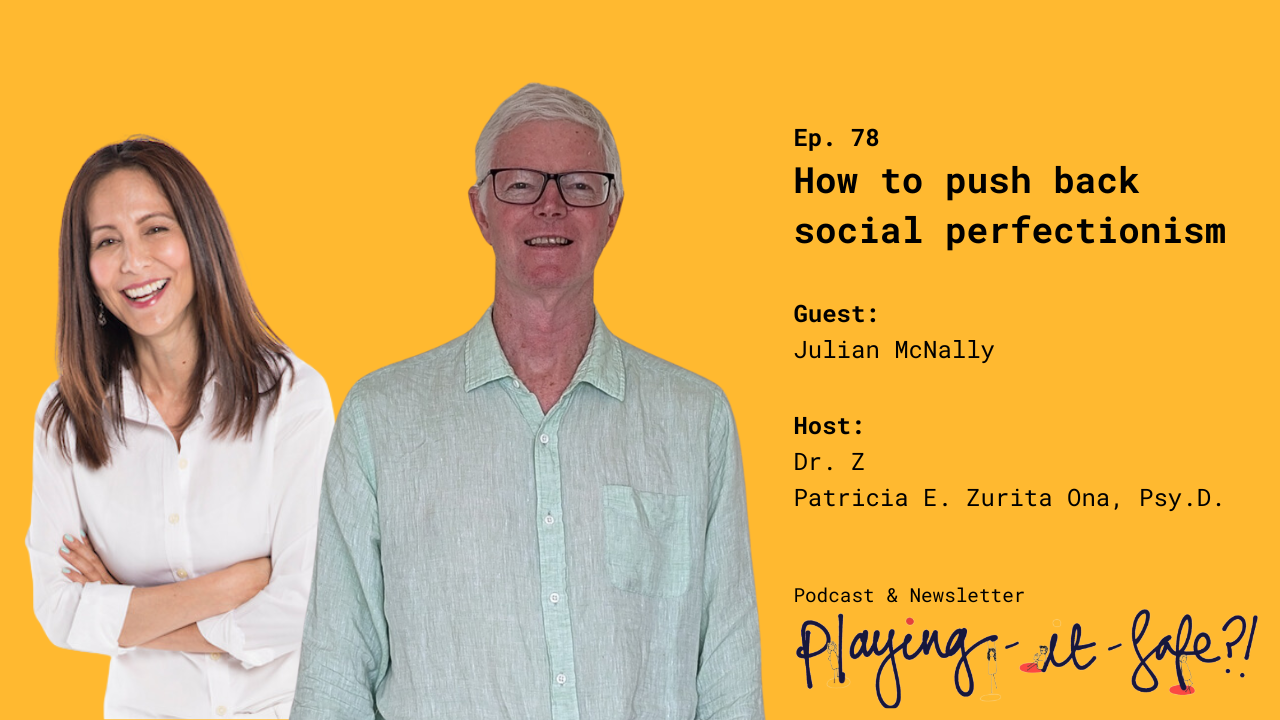
In this conversation with Julian McNally, M. Psych., we discussed acceptance and commitment skills for anxiety related to social situations.
Table of Contents
Key Takeaways
- How to live your values
- How to practice commitment
- Playing-it-safe
- How to manage negativity biases
- How to deal with comparison thoughts
- Context sensitivity
About Julian McNally
Julian McNally has practiced counseling psychology since 1995. He trained in client-centered and solution-oriented approaches before discovering Acceptance and Commitment Therapy in 2003. The mindfulness components of ACT harmonized with his long standing interest in Zen Buddhism and Taoism (Julian was a Tai Chi instructor for six years).
Shortly after reading Acceptance and Commitment Therapy by Hayes, Strosahl and Wilson, Julian started developing the world’s first online audio ACT training resource, 6 ACT Conversations through RMIT University.
In addition to seeing individuals for counseling, Julian also supervises other ACT practitioners in Melbourne, and throughout Australia and internationally.
He is principal psychologist at Melbourne’s first ACT center, The ACT of Living.
Resources
- Online audio ACT Training: http://emedia.rmit.edu.au/communication/.
- How Emotions Are Made: The Secret Life of the Brain by Lisa Feldman Barrett
- ACT of Living website: https://actofliving.com.au/
- ACT of Living’s Twitter: @actofliving
- Julian McNally’s LinkedIn: https://www.linkedin.com/in/julianmcnally
- Julian McNally’s Facebook: https://www.facebook.com/julianmcnally/
- Julian McNally’s YouTube: https://www.youtube.com/@julianmcnally5171
Resources from Dr. Z.
- Values-based journal: GET YOUR 22-PAGE TEMPLATE TO CHECK HOW YOU’RE “REALLY” LIVING YOUR LIFE
- Interview with Russ Harris